Life
1. EARLY LIFE
Francis Stephen Donnini was born November 30, 1921 in Providence, R.I. Not much is clear about his early childhood, but it is known that he was raised by his mother’s sister. He also spent part of his youth with his father, a butcher by trade.
Frank began painting at the age of five, drawing a portrait of Mickey Mouse. This was the beginning of a life long love affair of portraiture. Later in Frank’s childhood, his father became owner and manager of a traveling carnival show. There, at the age of 10, Frank did portraits and caricatures, charging 25 cents per piece.
One year later, at age 11, Frank won his first award… The Junior Achievement award from The Rhode Island School of Design (RISD). He then went on to win a full scholarship to the school at the age of 13.
After attending Hope High School in 1937, Frank attended RISD on his scholarship, and subsequently, the University of Chicago just before the start of World War II.
2. THE WAR YEARS
Frank joined the US Army in 1941… the onset of World War I. As with his early years, not much is known about his years in the war… This is due to both the secret nature of his intelligence work, but also his reluctance to talk about the events he saw and was thus a part of.
What is known is that he continued being a prolific artist during his years in the Army. From creating war bond materials to painting murals on planes and air force bases, he continued his love of art amidst the turmoil of war. He even won the Armed Forces Art Competition in 1943.
Yet, this time is perhaps best characterized by his envelope artwork… Hundreds of paintings, drawings, and sketches he did on war rationed paper. He took this rationed paper and art, folded it into envelopes, and sent them back to Lucille, a beautiful red head he fell in love with and married in 1943. The envelopes are still in the family’s possession and received the honor of being published in a major newspaper as a July 4th feature.

In his journal, Frank details his first experience with Lucille:
“I drove down town and decided to stop at Gibson’s (the old hangout for high school and college kids) for a “Coca Cola.” I went up to the soda fountain and sat on a stool; I was in a daze! I looked into the huge pink colored mirror. Then like a bolt of lightning in a deep black pit – it came upon me – I saw in the mirror a reflection of a smiling, gay, sweet carrot top girl sitting in a booth behind me. I turned abruptly and she gazed into my eyes at the same time and that lingered for a moment and she broke the spell with a very sweet “Hello Frank.” I went over to her booth and she introduced me to her cousin Eileen, to whom I must have seemed rude because all I could hear or see before me was Lucille.”
In 1944, Lucille and Frank had their first child, Elaine Susan. To his heartbreak, he could not be there for the birth of his first child. Known only to be in the European Theater, he finished his time in the army by liberating camp and war prisoners… An experience that made a profound impact on him for the rest of his life.
3. FAMILY & EARLY CAREER
After the war, Frank began focusing solely on his two loves: family and art. Over the next 17 years, he would have five additional children: Â Stephen, Ron, Claudia, Lisa, and Dana. His children influenced his artwork in many ways. One such example of this is his “Cloudscapes” series:
“I used to play a game and entertain my children, asking them to name objects they saw in cloud formations.”

As his family grew during the 1950’s and 1960’s, so did Frank’s career. To support both his family and art career, he began painting portraitures on the beach… Working up to 16 hours a day after his day job at The Miami News. His skill progressed to the point where he could even finish up to 25 portraits in one day. A glimpse at his early career shows that he mainly worked at advertising agencies (Metcalf, Bernstein, E.J. Schaeffer) and as an art director (Miami News, Loew’s) before setting out to start his own studio.
4. EXHIBITIONS & CRITICAL ACCLAIM
Helping to establish Frank’s Career and fund his new studio were the many exhibitions of which he was part. From 1959-1975, Frank had exhibits in multiple cities worldwide, including New York, Chicago, San Francisco, Miami, Mexico City, Paris, and Argentina. He was featured in such venues as:
- New England Art Show (1947)
- The Rhode Island School of Design Museum (1951)
- The Boston Museum of Fine Arts (1950)
- The New York World’s Fair (1964)
- The Florida World’s Fair (1965)
- The Modern Master in Water Color in New York (1965)
Critics were equally favorable towards Frank’s work. Examples of his reviews include:
- Dramatique” – France Amerique, New York
- “Explosive movement” – Art News
- “Imaginatively creative” – Pictures on Exhibit, New York
- “Wings of Color” – New York Journal American, New York
- “Sense of Urgency” – Manhattan East, New York
- “Purity of Conception” – Park East, New York
- “Excitement for the Viewer” – Miami Herald, Miami
- “Most Remarkable” – Miami News, Miami
And his paintings are in the permanent collection of many notable venues, including:
- Rhode Island School of Design
- State of Florida Supreme Court
- Loew’s Inc.
- Frank Sinatra
- Mrs. John F. Kennedy
- Mr. & Mrs. Joseph P. Kennedy
- Mrs. Rose Kennedy 1
His Cityscapes perhaps encountered the greatest acclaim, a subject that captured Frank’s own imagination:
“Forums and image of the city have always fascinated me, particularly the dramatic perspective of the buildings. They seem like living creatures, moving and breathing.”

5. PORTRAITS
Throughout the 60’s, 70’s and 80’s, Frank became well known for his portraiture work. These pieces were executed in pastels and oils, primarily in the traditional manner or impressionistic style. According to Frank, “If I didn’t paint portraits, I would be miserable.” He was commissioned by celebrities, politicians and the famous alike. Among those he painted include:
- Sammy Davis, Jr.
- President John F. Kennedy
- Nancy Kwan
- Justice Samuel Leibowitz 2
- Mayor Elliot Roosevelt 3
- Frank Sinatra
- Governor George Wallace 4
- Raquel Welch
Though he preferred not to get to know his subjects well 5, he did have stories to tell about those he painted. Among his favorite was Ernest Hemingway, whom he painted in Sloppy Joe’s bar in Key West, Florida. According to Frank, Hemingway was quite talkative on many subjects, but that fishing and sports were the things closest to his heart.
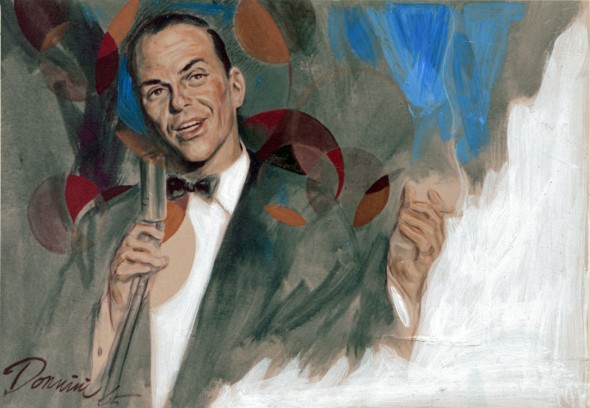
He also enjoyed his sitting with Frank Sinatra:
“Sinatra has quite a different personality. He doesn’t seem as aggressive as you hear.”
“Sinatra likes to paint and asked me about my technique. His paintings are very moody with dark colors and expressions. He’s pretty good at it.”
“Sinatra has tremendous animal magnetism. He is a stand-out in any crowd. He is quite unpredictable, which makes it great fun to work with him.”
Admittedly, his very favorite person to work with was Nancy Kwan, whom he painted a portrait for use in her movie, “The World of Susie Wong”:
“For such a young woman, she had such character.”
Yet, to many’s chagrin, he wasn’t as fond of the bombshell Raquel Welch, whose portrait was used in the advertising of her Sinatra film, “Lady in Cement”. (He subsequently painted a watercolor of the entire cast which appeared in Life magazine). About Mrs. Welch, Frank quipped:
“I didn’t recognize her when she first walked in. There are a lot of these girls who are better looking. She is not a great beauty, but, of course, she has had a little help here and there.” 6
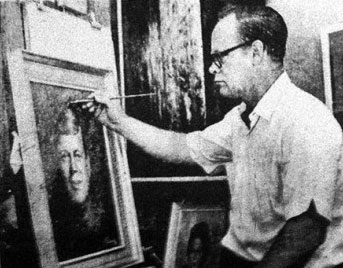
Yet, Frank’s most lasting legacy is his portrait of John F. Kennedy, one of only two portraits accepted by the Kennedy family after his assassination. Based on a photo taken by Charles Trainor of The Miami News, it was actually painted before his assassination. According to Frank:
“I saw something in that photograph that had a certain quality. At that time, Kennedy was going through the Bay of Pig crises and there was the threat of World War III. He looked worried.”
According to Mrs. Kennedy the painting was “a beautiful painting… a true likeness, an inspiring reminder.”
6. THE END OF A LIFE & CAREER
Yet, with all his success, Frank never wavered from who he was at heart… A generous, talented man who loved his wife and family dearly. Referred to lovingly as “Boompa” by his family, he is remembered fondly to this day. Memories of him are many, such as the time he brought home a monkey to serve as a pet for his 6 kids… Lucille did not take this well and – after many tears – neither the Frank or the monkey were allowed back into the house until a more suitable home was found.
Frank’s life came to a sudden, unexpected end when doctor’s found cancer in his lungs. Within a few months of the diagnosis, he passed away at the age of 59 in March of 1981 in Dallas, Texas.
“Life is art.” – Frank Donnini
FOOTNOTES
- The Kennedy family owns two of his pieces. A neighbor of Rose Kennedy purchased his study of Pope John for JFK’s mother, to which Rose Kennedy replied: “This true likeness of His Holiness [Pope Paul XXIII] will serve as an inspiring reminder of the happy occasions when we had the privileges of audience with him.”
- “Once a man came into my studio and asked me to do a portrait. After I started to sketch him, he said, ‘Don’t you want me to put on my robe?’ I didn’t have any idea who he was, but it turned out that he was Justice Samuel Leibowitz of New York.” – Frank Donnini
- “There beautiful picture you presented to me will be on of my cherished possessions… Your splendid reproduction from a newspaper picture is truly a great work of art. I accept it with deep gratitude and sincere appreciation.” – Elliot Roosevelt (April 12, 1966)
- “Its better for me not to know a person too well or I will put too much into a work. You can only put in one facet of the personality at a time.” – Frank Donnini
- “I guess I am spoiled. Stars are all beautiful to a certain extent but some are more photogenic than others. Without perfect makeup, many would pass unnoticed, were you to meet them on the street.” – Frank Donnini